
America at 250: What Can We Learn About Collective Consciousness?
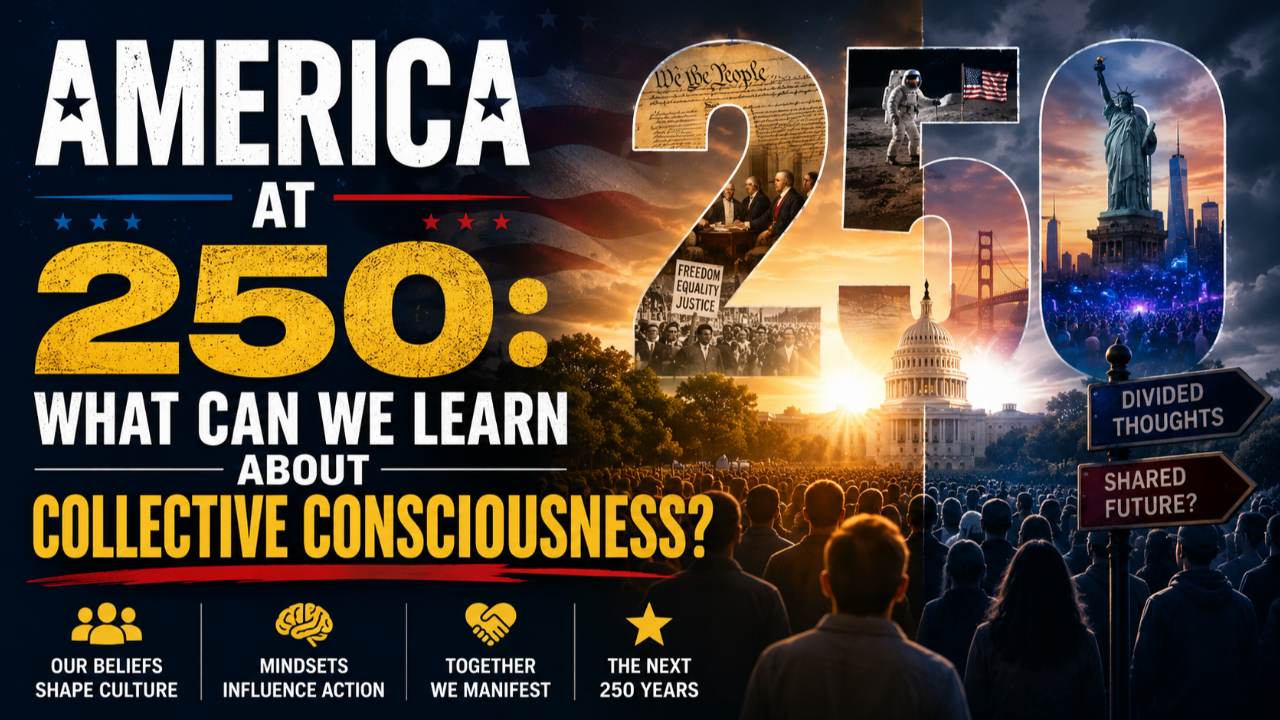
On July 4, 2026, the United States celebrated its 250th anniversary—a milestone few nations ever reach. Yet instead of entering its semiquincentennial with a clear sense of unity, America finds itself navigating one of the most polarized periods in modern history.
Political divisions dominate headlines, trust in institutions has eroded, and social media often amplifies conflict more effectively than consensus. As Graphic News noted in its overview of the anniversary, the celebration arrives amid ongoing debates over national identity, culture, and the country's future direction. Rather than diminishing the significance of the occasion, however, these tensions make the anniversary even more meaningful. They force us to ask not only where America has been, but where it is heading—and what role ordinary citizens play in determining that destination.
That question leads naturally into an idea that has fascinated philosophers, psychologists, and spiritual teachers for generations: collective consciousness. If individuals can shape their lives through their beliefs, intentions, and actions—as proponents of the Law of Attraction often suggest—could the same principle apply to an entire nation? Can millions of people, consciously or unconsciously, influence the direction of their society through the stories they believe, the expectations they hold, and the values they choose to reinforce?
Whether you approach that question from a spiritual perspective or a psychological one, history offers an intriguing answer: societies rarely become something they cannot first imagine.
More Than a Country—A Shared Story

Every nation is built on physical foundations—its borders, institutions, laws, and economy—but beneath those tangible structures lies something less visible and arguably just as influential. Nations are sustained by shared narratives. They are collections of ideas about who "we" are, what we value, what we fear, and what kind of future we believe is possible.
America has always been, perhaps more than any other country, an experiment built on an idea before it was built on geography. The Declaration of Independence was not merely a legal document announcing separation from Great Britain. It was a declaration of belief. It asserted that ordinary people possessed inherent rights and that government existed to serve them rather than rule over them. At the time, many considered those ideas radical or unrealistic. Yet because enough people believed they were worth pursuing, they eventually became the foundation of an entirely new nation.
That pattern has repeated itself throughout American history. Long before women gained the right to vote, someone had to imagine that political equality was possible. Before the Civil Rights Movement transformed the country, countless individuals had to reject the assumption that segregation was inevitable. Before astronauts walked on the Moon, an entire generation had to entertain the seemingly impossible notion that humanity could leave Earth altogether.
In each case, reality was preceded by belief.
Not belief alone, certainly, but belief strong enough to inspire action.
What Collective Consciousness Really Means
The phrase collective consciousness can sound abstract, but the concept itself is surprisingly practical. It simply refers to the shared beliefs, assumptions, values, and expectations held by a group of people. Every family has one. Every organization develops one. Entire cultures inherit them across generations.
You can often recognize a nation's collective consciousness by listening to the stories its people repeatedly tell.
Some countries see themselves primarily as survivors.
Others pride themselves on stability.
Others celebrate innovation or tradition.
America's story has always revolved around possibility. For generations, it has described itself as a place where reinvention is possible, where entrepreneurship is celebrated, where individual liberty matters, and where tomorrow can be better than today.
Whether those ideals have always matched reality is a separate conversation. The important point is that shared stories influence shared behavior. When enough people believe innovation is valuable, more businesses are started. When enough people value volunteerism, stronger communities emerge. When enough people believe civic participation matters, they vote, organize, and serve.
Beliefs become habits.
Habits become culture.
Culture shapes history.
The Law of Attraction Beyond the Individual
Most discussions of the Law of Attraction focus on personal transformation. People are encouraged to visualize success, practice gratitude, clarify their intentions, and align their actions with the life they hope to create. Critics often dismiss these practices as magical thinking, while supporters argue they simply help people become more intentional and focused.
Viewed through the lens of collective consciousness, however, the conversation becomes less mystical and more observable.
Imagine millions of people who genuinely believe innovation is possible. They are more likely to invest in education, experiment with new ideas, launch businesses, support scientific research, and encourage creative thinking in their children. None of those outcomes occur because thoughts magically reshape reality. They occur because shared expectations influence countless individual decisions.
The same principle works in reverse.
If enough people become convinced that decline is unavoidable, they begin behaving accordingly. They invest less in their communities, trust one another less, avoid long-term planning, and interpret setbacks as confirmation that improvement is impossible. Over time, those behaviors can reinforce the very decline they feared in the first place.
This is one reason psychologists have long studied self-fulfilling prophecies. Expectations influence behavior, and behavior often influences outcomes. The Law of Attraction, stripped of its more supernatural interpretations, can be understood in much the same way. Attention shapes perception. Perception influences choices. Choices accumulate into reality.
Multiply that process across hundreds of millions of people, and you begin to understand how national attitudes can shape national outcomes.
The Stories America Chooses to Repeat

As America reaches its 250th birthday, it finds itself telling two very different stories about its future.
One story is rooted in pessimism. It argues that political dysfunction is permanent, that neighbors can no longer trust one another, that institutions are beyond repair, and that the nation's best years are already behind it. Every news cycle, every viral argument, and every political controversy becomes additional evidence supporting that conclusion.
The other story acknowledges the country's flaws without allowing them to define its future. It recognizes that America has endured civil war, economic depression, social upheaval, terrorism, and global conflict before emerging changed but not destroyed. This perspective does not ignore present challenges; it simply refuses to believe that today's difficulties are the final chapter.
Neither story is entirely objective.
Both involve interpretation.
And interpretation matters because people naturally act according to the stories they believe.
If citizens assume cooperation is impossible, they stop trying to cooperate. If they assume every disagreement is evidence of moral failure, compromise begins to look like betrayal. If they believe nothing can improve, they gradually withdraw from the very activities that make improvement possible.
Conversely, when people believe progress remains achievable, they are more likely to volunteer, mentor, vote, innovate, build businesses, strengthen neighborhoods, and invest in future generations. Optimism does not guarantee success, but it often encourages the behaviors that make success more likely.
Manifestation Requires Movement
One of the biggest misconceptions surrounding the Law of Attraction is that belief alone creates outcomes. History offers little evidence for that claim.
No social movement succeeded because people simply visualized change.
No scientific breakthrough emerged because researchers wished hard enough.
No great civilization prospered by replacing effort with affirmations.
Belief matters because it directs action, not because it replaces it.
The abolitionist movement succeeded because conviction inspired organization. The space race succeeded because imagination fueled decades of engineering and scientific work. Economic prosperity has repeatedly followed periods in which people were willing to invest, build, invent, and accept risk despite uncertainty.
Manifestation, at its most practical, is the process of aligning belief with behavior over an extended period of time. The same principle applies to individuals, businesses, and nations alike.
A country's future is shaped less by what it hopes will happen than by what its people consistently choose to build.
America's Next Chapter Hasn't Been Written
Anniversaries invite nostalgia, but they also invite responsibility. Looking backward can be inspiring, yet the greater challenge is deciding what comes next.
Every generation inherits a nation shaped by the decisions of those who came before. At the same time, every generation becomes responsible for the stories future generations will inherit. Today's children will eventually look back on this era and decide whether it was remembered primarily for division or for renewal, for cynicism or resilience, for retreat or reinvention.
That decision is not made by presidents alone. It is made by teachers who inspire curiosity, entrepreneurs who solve problems, neighbors who strengthen communities, artists who imagine new possibilities, volunteers who serve without recognition, and ordinary citizens who refuse to believe that polarization is the only possible future.
Collective consciousness is not some mystical force floating above society. It is the accumulation of millions of individual choices repeated day after day. Every conversation, every vote, every business created, every act of kindness, and every story shared contributes, however modestly, to the atmosphere a nation creates for itself.
As America celebrates 250 years of independence, perhaps the most meaningful question isn't whether the country has lived up to every ideal written into its founding documents. No nation ever fully does.
A better question is this:
What kind of future are Americans collectively choosing to imagine—and are their daily actions bringing that future any closer?
Because history suggests that the greatest transformations rarely begin with certainty. They begin when enough people decide that a better future is possible, and then commit themselves to building it together.
https://www.graphicnews.com/en/pages/48163/world-agenda-july-2026
Discover How To Manifest In Your Sleep
Stay connected with news and updates!
Recent Posts