
The Science of Hope During Uncertain Times
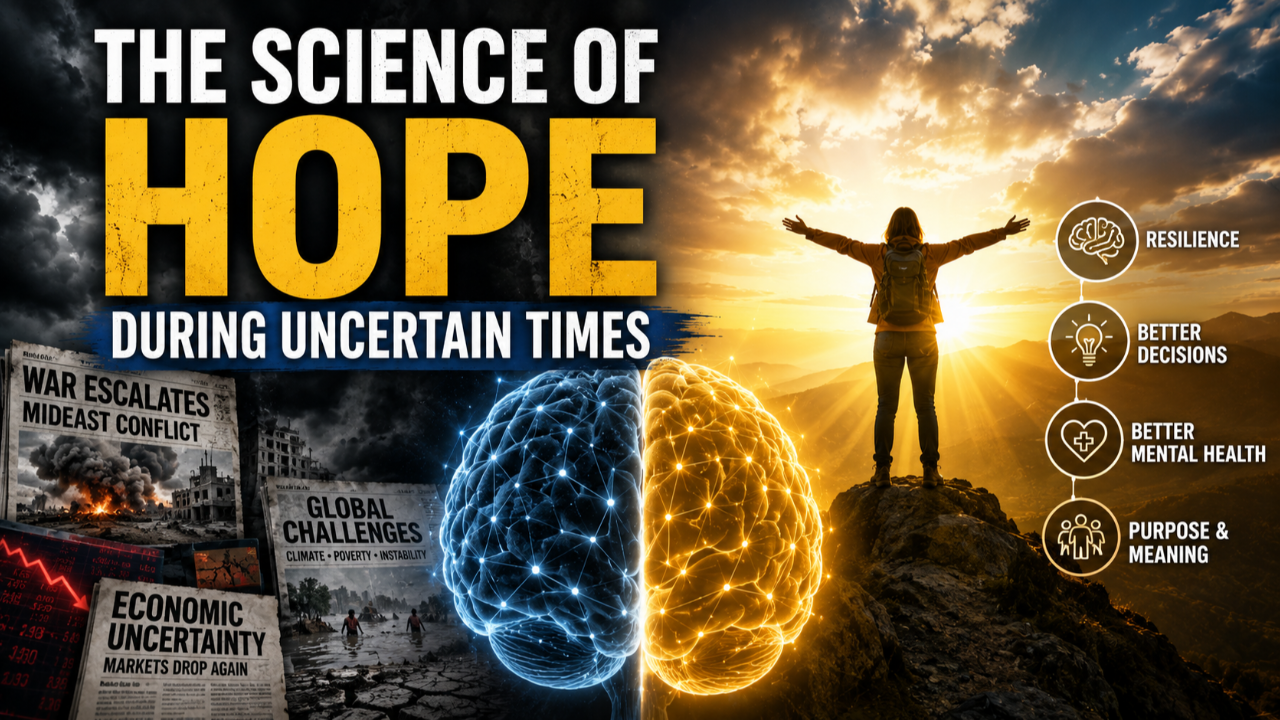
There are moments when hope can feel almost irresponsible. Wars dominate the headlines, economic forecasts wobble, institutions lose public trust, and entire populations seem to be living with a quiet background hum of anxiety. The IMF’s July 2026 outlook describes a global economy that is still growing but unevenly, shaped by war-related energy shocks in some regions and technology-driven growth in others. Reuters has also reported continuing concern around the Iran war, energy markets, inflation pressure, and broader geopolitical uncertainty.
In a world like that, optimism can sound naïve. But science suggests something more interesting: hope is not denial. Real hope is a psychological resource. It helps people think more clearly, recover more effectively, and keep taking constructive action when circumstances feel unstable. The mistake is assuming hope means pretending everything is fine. It does not. Hope means believing that your choices still matter, even when the outcome is not guaranteed.
Psychologist Charles Snyder’s well-known hope theory describes hope as more than a positive feeling. It involves goals, pathways, and agency, the ability to imagine a desired outcome, identify possible routes toward it, and believe you can take meaningful steps. That definition matters because it separates hope from passive wishing. Wishing says, “I hope things get better.” Hope says, “Things are difficult, but there may still be a way through, and I can participate in finding it.”
This distinction is especially important during uncertain times. When people feel powerless, they often freeze. They avoid decisions, catastrophize the future, or consume more news than their nervous system can handle. Hope interrupts that spiral by giving the mind a task. Instead of asking, “What if everything falls apart?” it asks, “What is still possible from here?” That question does not solve war, inflation, climate stress, or political conflict. But it can change how a person responds to them.
Research on optimism supports this idea. A meta-analysis published in Annals of Behavioral Medicine reviewed 83 studies and found that optimism was associated with better physical health outcomes. Another review in Clinical Practice & Epidemiology in Mental Health concluded that optimism may support well-being by encouraging healthier behaviors, more flexible thinking, better problem-solving, and more adaptive responses to negative information.
That last point is crucial. Optimistic people are not necessarily people who avoid bad news. In many cases, they are people who process bad news without becoming completely defined by it. They are able to recognize danger while still searching for options. That mental flexibility can improve decision making because panic narrows attention, while hope widens it. A person who believes the future is already doomed may stop saving money, caring for their health, repairing relationships, or participating in community life. A hopeful person is more likely to ask what can still be protected, improved, or rebuilt.
Purpose works in a similar way. A study published in Emotion found that purpose in life may act as a resilience factor, helping protect against depression and post-traumatic stress after exposure to stress or trauma. The researchers suggested that purpose may support automatic emotion regulation after negative emotional experiences.
That means purpose is not just a poetic idea. It may help the brain recover. When life feels uncertain, purpose gives suffering a frame. It reminds people that they are not merely reacting to events; they are still oriented toward something meaningful. A parent may endure economic anxiety because they are focused on creating stability for their children. A nurse may continue showing up during crisis because their work is connected to service.

A young person may stay engaged with the future because they feel called to create, lead, heal, build, or contribute.
This is why “staying positive” is often the wrong advice. Positivity can feel shallow when people are facing real hardship. Hope is deeper because it makes room for grief, fear, anger, and uncertainty. It does not require pretending the world is simple. It simply refuses to let difficulty become the only story.
There is also a social dimension to hope. The Reuters Institute’s 2026 Digital News Report describes global news audiences as increasingly uneasy amid political, economic, and technological turbulence. That unease is understandable, but constant exposure to crisis can distort perception. When every headline feels urgent, the mind begins to mistake intensity for inevitability.
Hope helps restore proportion. It reminds us that headlines capture what is happening, not everything that is happening. Wars exist, but so do peace efforts. Economic instability exists, but so do adaptation, innovation, and recovery. Social division exists, but so do acts of generosity, courage, and cooperation that rarely trend online. Hope does not erase danger. It widens the lens.
The most practical kind of hope is built through action. That might mean limiting doomscrolling, strengthening relationships, volunteering locally, building emergency savings, caring for physical health, learning a useful skill, or choosing one issue to support instead of trying to emotionally absorb every crisis on Earth. These actions may seem small compared with global problems, but they restore agency. And agency is one of the foundations of hope.
During uncertain times, the goal is not to be blindly optimistic. The goal is to become usefully hopeful. Blind optimism says, “Everything will work out.” Useful hope says, “I do not know exactly what will happen, but I can still choose my response, protect my values, and take the next right step.”
That kind of hope is not weakness. It is discipline. It is the decision to keep your imagination alive when fear wants to colonize it. It is the refusal to confuse uncertainty with impossibility. And in a world filled with reasons to despair, maintaining hope may be one of the most rational things a person can do.