
Can AI Help You Manifest Your Goals?
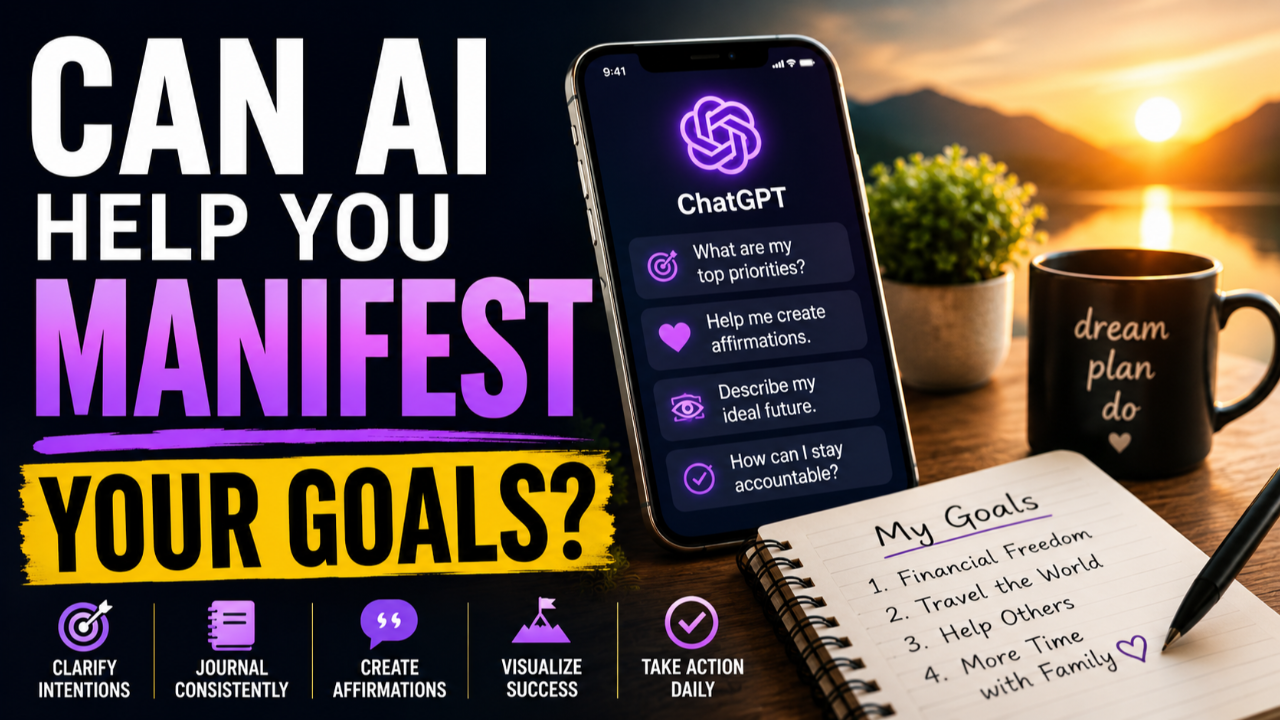
How ChatGPT Can Become Your Thinking Partner—Without Becoming Your Life Coach
"Manifestation" is one of those words that instantly divides people. Some hear it and think vision boards, affirmations, and the law of attraction. Others dismiss it as wishful thinking.
But strip away the buzzwords, and manifestation is really about something much more practical: getting clear on what you want, reinforcing it consistently, and taking actions that move you toward it.
That's where AI enters the conversation.
Not because ChatGPT can magically attract your dream job or soulmate—but because it can remove one of the biggest obstacles between people and their goals: unclear thinking.
As artificial intelligence becomes part of daily life, many people are discovering that AI works surprisingly well as a reflection tool. It asks questions, organizes thoughts, generates ideas, and helps people stay consistent with habits that are notoriously difficult to maintain alone.
The important distinction?
AI can support manifestation. It cannot replace action.
Manifestation Has Always Been About Repetition
Whether you believe in manifestation spiritually or psychologically, most successful approaches share the same pattern:
- Clarify what you want.
- Repeat it often enough to stay focused.
- Make decisions that align with that vision.
- Adjust when reality changes.
Notice what's missing.
There's nothing magical about writing affirmations once and waiting for the universe to respond.
Consistency—not inspiration—is usually what separates people who achieve goals from those who abandon them after a few weeks.
Ironically, consistency is exactly where AI excels.
Unlike a notebook that sits unopened on your shelf, ChatGPT never runs out of prompts, questions, or fresh perspectives.
AI Can Help You Clarify What You Actually Want
One reason goals fail is that they're often borrowed.
"I want to be successful."
"I want financial freedom."
"I want happiness."
These sound motivating until someone asks:
"What does that actually look like for you?"
Many people can't answer.
Instead of giving you another generic productivity framework, AI can keep asking increasingly specific questions until your goal becomes tangible.
For example:
"I want more freedom."
AI might respond:
- What does freedom mean in your daily routine?
- What would a normal Tuesday look like if you had it?
- What's stopping you today?
- Which obstacle is within your control?
After fifteen minutes of conversation, vague ambition becomes something measurable.
That's not manifestation.
That's clarity.
And clarity often changes behavior.
AI Makes Journaling Easier Than Starting From a Blank Page
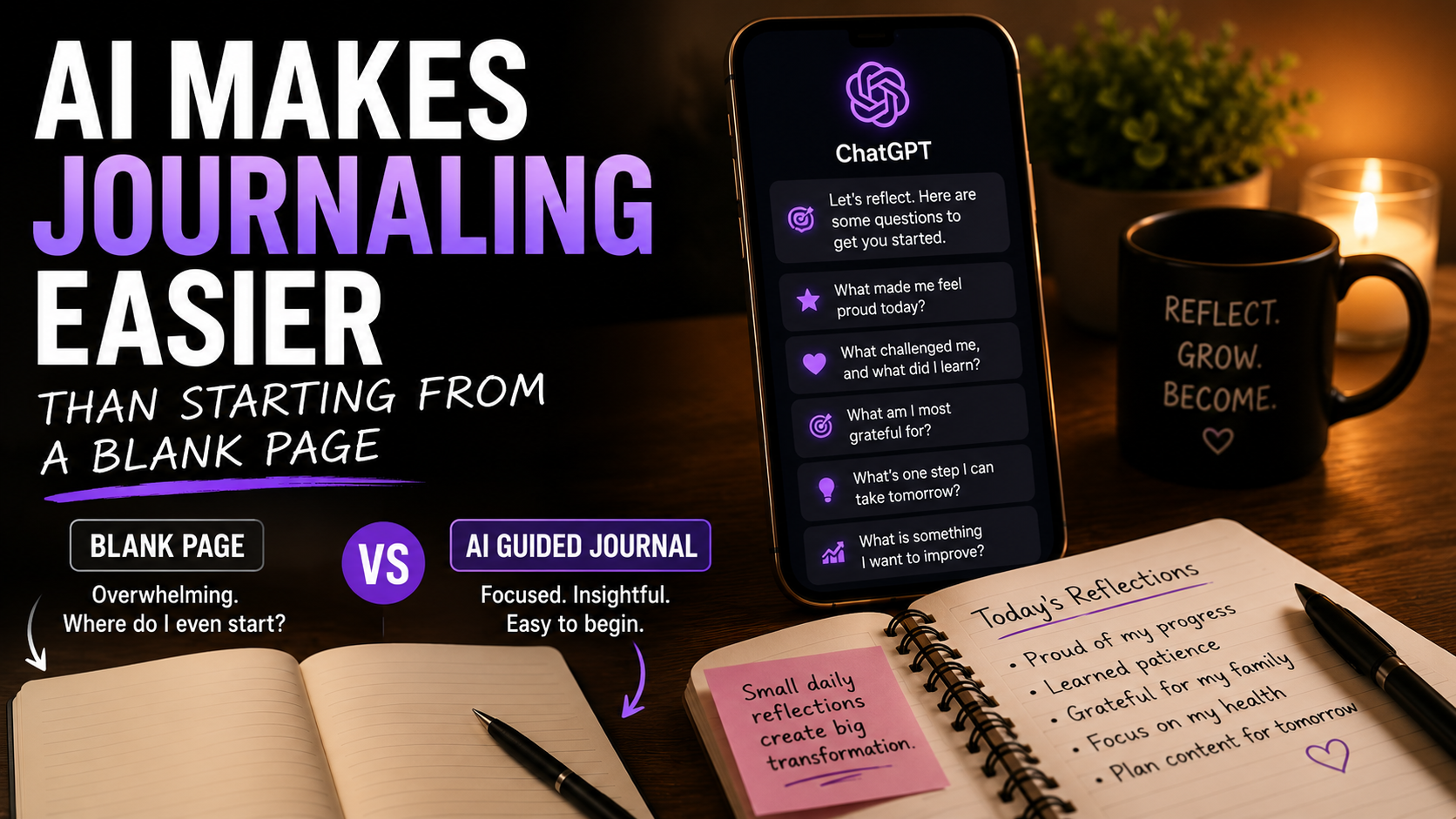
Most people know journaling helps.
Very few people enjoy staring at an empty page.
This is one area where AI quietly solves a huge problem.
Instead of asking yourself:
"What should I write?"
You can ask ChatGPT:
"Ask me five questions that help me understand why I'm procrastinating."
Or:
"Help me reflect on what went well today instead of what went wrong."
The result feels less like writing an essay and more like having a thoughtful conversation.
Over time, those conversations create something valuable:
Patterns.
You begin noticing recurring fears, recurring wins, recurring excuses, recurring motivations.
Those insights are much harder to discover without consistent reflection.
AI Can Personalize Affirmations So They Don't Sound Fake
Many affirmations fail because they're unbelievable.
If you're overwhelmed with debt, repeating:
"I am incredibly wealthy."
may create more internal resistance than motivation.
AI can rewrite affirmations so they feel grounded instead of performative.
Instead of:
"I am perfectly confident."
It might generate:
"I'm becoming more confident each time I practice difficult conversations."
That's subtle.
But psychologically, it's much easier to accept.
The affirmation becomes something your brain can actually work toward instead of reject.
Visualization Becomes More Detailed With AI
Elite athletes have used visualization for decades.
The difference is that most people don't know how to visualize effectively.
Instead of imagining a vague future, AI can help construct detailed scenarios.
Imagine prompting:
"Describe what my ideal workday looks like if I've built a successful design business."
The response might walk through:
- your morning routine,
- the clients you're working with,
- the problems you're solving,
- how you spend your afternoons,
- even how you feel at the end of the day.
Suddenly, the goal becomes easier to picture.
That matters because specific mental imagery often improves motivation and planning.
Visualization isn't valuable because it predicts the future.
It's valuable because it makes the future easier to prepare for.
AI Can Become an Accountability Partner—If You Let It
Motivation disappears.
Systems remain.
One overlooked use for ChatGPT is accountability.
Rather than asking for inspiration every Monday, you can create recurring check-ins.
Examples include:
- reviewing weekly progress,
- identifying obstacles,
- celebrating small wins,
- adjusting next week's priorities,
- challenging excuses before they become habits.
Unlike many productivity apps, the conversation evolves with you.
If your priorities change, your AI coach changes too.
The Biggest Risk: Mistaking Conversation for Progress
Here's where people get into trouble.
AI is incredibly satisfying to talk with.
Planning feels productive.
Brainstorming feels productive.
Refining your vision feels productive.
None of those things are the goal.
The goal is action.
Interestingly, one insight from the Independent International Scientific Panel on AI's Preliminary Report is especially relevant here. The report notes that AI creates the greatest value when it's embedded within real workflows and supported by complementary habits, skills, and institutional systems—not when it's treated as a replacement for human effort. In other words, AI works best as an amplifier of action rather than a substitute for it.
That applies just as much to personal growth.
If AI helps you journal...
Great.
If it helps you organize your week...
Even better.
But if you spend three hours perfecting your five-year vision instead of making one sales call, writing one chapter, or going to the gym...
AI has become another form of procrastination.
Why Reflection Matters More Than Predictions
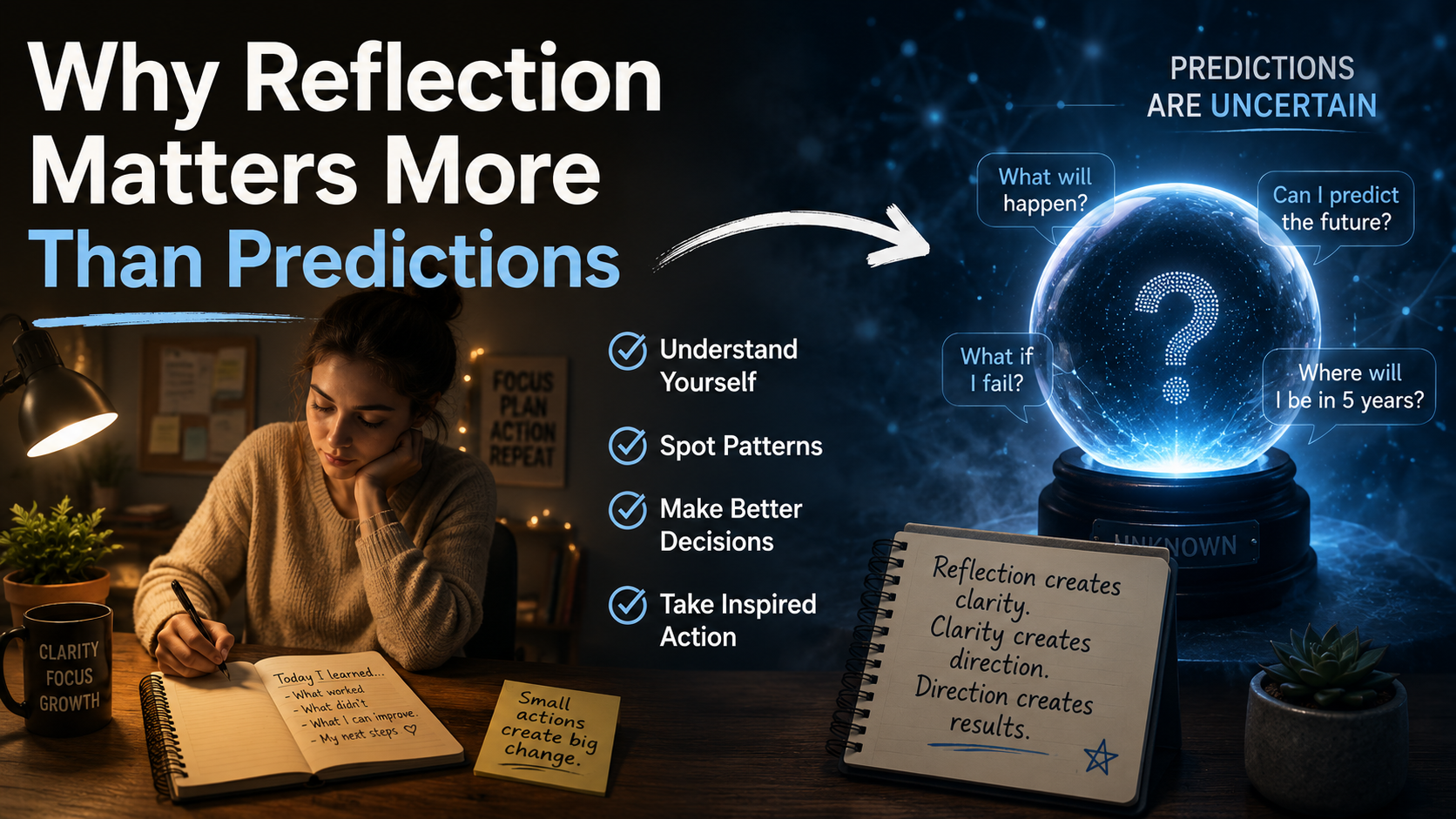
One refreshing point made in the UN panel's report is that today's AI systems are excellent at organizing information, generating ideas, and assisting knowledge work—but they still have important limitations around factual reliability, judgment, and autonomy. The report repeatedly emphasizes that AI should support human decision-making rather than replace it.
That makes it a surprisingly good partner for manifestation.
Not because it knows your future.
Because it helps you think about it more clearly.
It asks better questions than most people ask themselves.
Sometimes that's enough to change what happens next.
A Better Way to Think About AI and Manifestation
Maybe manifestation isn't about attracting opportunities.
Maybe it's about becoming someone who notices opportunities that were already there.
If that's true, AI can help.
Not by sending success into your life.
But by helping you:
- clarify your intentions,
- challenge limiting assumptions,
- maintain consistent reflection,
- build practical habits,
- and stay accountable between moments of inspiration.
The future isn't created in one breakthrough conversation with ChatGPT.
It's created through hundreds of small decisions that follow.
AI can help shape those decisions.
The walking still has to be done by you.
Final Thoughts
The most powerful way to use AI isn't as an oracle predicting your future—it's as a thinking partner that helps you understand yourself better.
Manifestation has always depended on attention, consistency, and action. ChatGPT simply makes those practices easier to sustain. It can help you journal when you don't know what to write, refine affirmations so they feel authentic, visualize meaningful goals with greater detail, and hold you accountable to the commitments you make.
Used this way, AI doesn't replace intuition, discipline, or effort. It strengthens them.
And perhaps that's the most realistic kind of manifestation: not expecting technology to change your life for you, but using it to become more intentional about changing your life yourself.
Reference: Preliminary Report of the Independent International Scientific Panel on AI (United Nations, July 2026).